All articles tagged ‘Surrey’

Are TransLink’s station naming rights for sale?

  Frederick Linsmeyer • July 20, 2011 • Local

To help solve some of TransLink‘s funding for future projects, the mayor of Surrey has a suggestion for the transit organization – corporate naming rights. Diane Watts suggests that funds could come from corporate sponsors which in turn would help pay for infrastructure upgrades and extensions, like the controversial Evergreen Line. Mayors from around Metro Vancouver have recently proposed a hotly contested gas tax to come up with the remaining money to push the Evergreen Line through.

To be fair, it’s not a far fetched thought as other agencies have reached out to corporations for extra cash. The Chicago Transit Authority has tossed around a similar idea after allowing computer giant Apple to contribute funds towards renovations of an L station. New York City’s Metropolitan Transportation Authority sold the rights for a single station to the London-based bank Barclays in 2009. It’s possible that Vancouver Canucks fans and tourists to Chinatown could alight at Rogers Arena-Stadium Station if Watts’ idea passes.

Would selling the naming rights to corporations bring in much needed revenue to the cash-strapped system? Or could the idea cause confusion to both locals and visitors alike with unrelated station names? The next station is for sale!

Sources: News1130, CTV British Columbia

Canada Day Events 2011

  Frederick Linsmeyer • June 26, 2011 • Local
O Canada!

O Canada!

It’s time to celebrate Canada Day this coming Friday! As always, there are plenty of parties and events going on throughout Metro Vancouver this year, with bands, interactive exhibits, games, family-friendly activities, cake and fireworks!

This is just a small list of everything that’s planned for this long weekend, so be sure to consult your local community calendar for an event nearest you.

Watching the Canucks outside

  Frederick Linsmeyer • May 31, 2011 • Local
TransLink bus with Canucks wrap

Follow the Canucks bus to Rogers Arena!

In a true hockey nation, the City of Vancouver is setting up two large screens to broadcast the Stanley Cup Finals between the Vancouver Canucks and Boston Bruins.

The first screen will be setup to compliment the existing one outside the CBC building on Hamilton Street between Georgia and Robson Streets.

The second screen will be placed on Granville Street, also between Georgia and Robson Streets. Food carts and portable washroom facilities are also being made available to make sure fans are well fed and looked after.

Georgia Street will be closed off between Richards and Cambie Streets

There’s also a display on the south-side of the Pan Pacific Hotel at Canada Place.

The Burnaby Public Library just west of Metrotown at the corner of Willingdon Avenue and Kingsborough Street is also bringing in a big screen for fans to watch.

If you don’t feel like travelling into the city for the party, Surrey is also showing the series at Central City Plaza on 10153 King George Boulevard. The City of Surrey web site mentions the first four games (which means they’re favouring a Canucks sweep).

TransLink will be offering increased SkyTrain and bus service to help get fans to and from the party zones.

All locations are free to attend.

Game 1 is on Wednesday at 5:00 pm PDT.

Transit ideas for Surrey’s future

  Frederick Linsmeyer • October 12, 2010 • Local
Mark I series SkyTrain approaches Main Street - Science World

Mark I series SkyTrain approaches Main Street - Science World

TransLink is looking for input on the future of rapid transit for Surrey. Fast becoming one of the largest cities in the province, Surrey’s population is looking for a reliable and efficient way to get around. As a result, TransLink is conducting a study to see what residents are looking for in providing prospective services for the future.

Some of the ideas TransLink has come up with utilize bus rapid transit, light rail transit or rail rapid transit. Some of these methods would run down busy streets and highways — King George Boulevard, Fraser Highway, 104th Avenue, and 152nd Street.

Community workshops will be open to the public to allow residents to provide feedback and participate in discussions on the type of transit solutions that would benefit the community. Alternatively, online questionnaires are available for those who may not be able to attend any of the sessions.

Celebrating Canada Day

  Frederick Linsmeyer • June 14, 2010 • Local
Come out and celebrate Canada's birthday!

Come out and celebrate Canada's birthday!

Canada is celebrating her 143rd birthday this July 1st, and it’s time to break out the red and white again! There will be plenty of parties in and around Metro Vancouver, so take a look below to see what’s happening near you!

The Olympic Cauldron by the Vancouver Convention Centre will be re-lit again for Canada Day. Head on down to Canada Place if you missed seeing the flame during the Olympics.

SkyTrain

  Frederick Linsmeyer • January 15, 2010 • Trains
SkyTrain at Commercial Drive

A Mark I series train at Commercial-Broadway station

The future of rapid transit is here! Since opening in 1985, SkyTrain has become an integral part of transportation in Metro Vancouver. Linking the communities of Vancouver, Burnaby, Coquitlam, New Westminster and Surrey together, SkyTrain utilizes close to 49 km of track with 33 stations on two lines: The Expo Line and Millennium Line.

The Expo Line was completed in time for Expo 86 with extensions in 1989, 1990 and 1994, and the Millennium Line was opened in 2002, and then extended in 2006. A third proposed line, the Evergreen Line, which will diverge from the Millennium Line at Lougheed Town Centre and terminate at Douglas College in Coquitlam, is expected to be completed in 2014. Other possible extensions see the Expo Line extended further into Surrey, and the Millennium Line running out west to the University of British Columbia.

View from the front of a Mark II car

View from the front of a Mark II series car

SkyTrain is unlike other rapid transit systems, operating driver-less trains and using a unique traction method. The entire system is remotely operated from the control centre in the Edmonds yard out in Burnaby. Automation allows for better headway, especially during peak hours and isn’t subject to the same mistakes humans make. As a result, the system has never experienced any collisions, just a minor derailment on a non-revenue stretch of track.
Although the system is automated, SkyTrain Attendants can manually drive a train during emergencies or other situations. In the winter time, SkyTrain Attendants ride upfront to visually monitor the tracks for snow buildup or other obstacles created by inclement weather.
Trains on the Expo and Millennium Lines are propelled using linear induction motors — which means the cars are essentially being pushed along by magnets. This propulsion method is quite evident from the aluminum clad plates that are mounted between the running rails. The linear induction technology allows for less moving parts and a much smoother ride with speeds up to 80 km/h. Contrary to popular belief, the SkyTrain is not a monorail despite the visibility of the aluminum centre plate; the cars do run on a set of standard gauge (1,435 mm/4 ft 8½ in) rails. The trains are fed by two power rails placed vertically along the side of the tracks, with the top rail charged at +300 volts DC, while the bottom rail is charged at -300 volts DC.
The location of the trains are tracked through two wires mounted near the aluminum centre plate, while communications between the on-board computers, passenger intercom, and announcements are managed via radio through an antenna on the car roof.

As the system is automated, special devices have been implemented to ensure passenger safety. If a person or large object lands on the track, an audible alarm will sound and will stop any oncoming trains until the alarm has been manually reset. On the platform, special panels feature a red telephone with a direct line to the control centre, an emergency train stop button and a fire extinguisher. The panels also outline safety and security procedures to provide a hassle free ride. Security cameras are also present, linked directly to the Control Centre and are used to monitor platforms, stairways and escalators.
Inside the train, speaker phones are located near the doors and connected to the control centre. There is also a silent alarm strip mounted on each of the windows should an incident prevent use of the speaker phone. Fire extinguishers are stored underneath the seats, usually behind a panel for normal storage. The side doors are designed to re-open if a person or object is caught between them when closing. In the event the doors cannot be opened automatically (or during an emergency), latches located above the doors and on the outside of the car can be used for manual operation.

An eastbound Mark I series train leaves New Westminster station

An eastbound Mark I series train leaves New Westminster station

When SkyTrain first began operation, Urban Transportation Development Corporation (UTDC) manufactured the rectangular Mark I cars which feature two doors and three large windows per side with top mounted hopper windows, and a single door on the ends (for emergency or operator use). The interiors have 36 seats, with those in the middle of the car facing the aisle, for a total capacity of 80 passengers. The 12 m long cars are permanently coupled together in married pairs.
In 1991, UTDC manufactured additional cars for the extension of the Expo Line to Scott Road and again for the lengthening of the line to King George in 1994. These cars are a variant of the Mark I, which are aptly named Mark Ia, and saw the removal of the end doors and increased space by the side loading doors.
Interestingly enough, the Mark I cars did not always open all of the doors when stopped at a station platform. Passengers would press a button on the outside of the door, or inside on one of the stanchions, to open the doors should they need to board or exit the train. This feature was removed during the early 1990s due to passenger confusion and frustration.
All of the original 150 Mark I cars are still in operation.

SkyTrain at Lougheed Town Centre

A Mark II series train at Lougheed Town Centre station

With the Millennium Line under construction, Bombardier, which acquired UTDC, was contracted to manufacture new cars. The Mark II cars were built in a facility in Burnaby near the Edmonds yard. The Mark II cars are 17 m in length, feature aerodynamic ends with a large window, three doors and four large windows per side, air conditioning, and are permanently coupled together in 34 m pairs. The spacious interiors provide more room for standing passengers and have 41 seats arranged in a theatre-style. The Mark II design also allowed an articulated joint between the two cars to increase passenger capacity and as a result of this, Mark II cars are permanently coupled together in pairs.
Bombardier was tasked again 2006 to provide 34 new Mark II cars, labelled as Mark II 1300/1400, in anticipation of increased ridership and the upcoming Olympic Winter Games. The same aerodynamic theme would be used again, but would have upgraded amenities – LED destination signs on the ends, LED station maps, security cameras and door indicator lights. There are 108 Mark II cars in operation.

Most Mark I trains are run as 4 car consists, but can be run as short as 2 or as long as 6 cars, which is the maximum limitation due to station design. The Mark II trains are run as two car consists, but can be run up to 4 car consists, again due to station size limitations. Longer car configurations are only seen during busier times, including rush hours, or special events.

BC Transit Logo

BC Transit Logo

Over the years, the SkyTrain cars have gone through a few livery changes. During Expo 86, the trains sported red and blue stripes with the letters BC in blue and a stylized provincial flag. The majority of the cars were labelled with communities from across the province, such as “Spirit of Kelowna” or “Spirit of Nakusp.” When TransLink took over BC Transit’s operations in the Metro Vancouver region in 1998, a number of the Mark I cars were stripped of their decals and given a bland white appearance with the blue and yellow scheme familiar to TransLink. A few cars still retain the red and blue stripes, but have the TransLink logo instead of the BC Transit emblem.
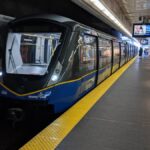
When the Mark II cars were delivered, the cars appeared completely white with the exception of the blue and yellow bands and word “SkyTrain” in blue near the front. However, the newer Mark II 1300/1400 series car came with an updated colour scheme: charcoal and blue separated by a thin stripe of yellow. The design is similar to those on the original Mark II cars except that the blue band is grey due to the background colour. The SkyTrain logo appears in white near the ends of the cars.

One of the system’s most notable features are the automated announcements and door chimes. Karen Kelm originally voiced the station announcements with the famous “The next station is…” phrase. When the Millennium Line was completed in 2002, Laureen Regan took over as the voice of SkyTrain and now advertises the next stop and line the trains travel.
Also unique to the system, a three toned chime plays when the doors are about to close, which differs from the standard vocal warning used elsewhere. With the introduction of the Mark II 1300/1400 cars, an amber light in the doorway blinks when the chimes play providing a visual alert to passengers who may have difficulty hearing.

TransLink Transfer purchased from a Ticket Vending Machine

TransLink Transfer purchased from a Ticket Vending Machine

SkyTrain doesn’t utilize turnstiles at stations, but operates on a proof of purchase system. Passengers purchase fares from ticket vending machines or cards/passes from authorized vendors and retain them for the duration of the trip. Fares are based on a system of zones, of which there are three: Zone 1 is Vancouver, Zone 2 includes Burnaby, Richmond, New Westminster, North Vancouver (city and district), West Vancouver and Bowen Island; Zone 3 includes Delta, Surrey, Coquitlam, Port Coquitlam, Port Moody, Langley, Maple Ridge and Pitt Meadows. Upon purchase, the fare is good for travel on the system (including the Canada Line, buses and the SeaBus) for up to 90 minutes.
Random fare inspections are performed by the blue jacketed SkyTrain Attendants or officers of the South Coast British Columbia Transportation Authority Police Service and can occur at any time; at entrances to the platform level, on the platforms and on board trains.
A plan to install turnstiles at all stations has been proposed by TransLink and is currently in the design phase.

Mark I series SkyTrain approaches Main Street - Science World

Mark I series SkyTrain approaches Main Street - Science World

The name SkyTrain comes from the fact, the majority of the system is elevated. The elevated structure is a viaduct constructed of prefabricated concrete sections and is designed so that pedestrians or traffic don’t have to encounter the trains or electrified rails. Some portions, including downtown Vancouver, between New Westminster and Columbia stations and after the Columbia station run underground, while sections between Nanaimo and Joyce, Edmonds and 22nd Street run at grade.
Under downtown Vancouver, the SkyTrain runs in an old Canadian Pacific Railway tunnel, which was built in 1932, to connect the company’s yards on Burrard Inlet with the yards and shops on False Creek. The eastern portal is south of the Stadium-Chinatown station and is obscured by the recent construction of new high rises. The western portal is just north of the Burrard station, below the Vancouver Convention Centre. The tunnel’s width prevented both tracks from being run side-by-side, so in the 1980s the bottom of the tunnel was dug out, which allowed the westbound track stacked above the eastbound track.
After the Expo Line branches off east of the Columbia station, the tracks have to cross the Fraser River in order to reach Surrey. Originally, the SkyTrain system terminated at New Westminster until the SkyBridge, a 616 m long cable-stayed bridge, was constructed in 1989 to allow the first extension over the river. The SkyBridge is unique due to the fact it only carries the Expo Line — other vehicles cross the Fraser River on the Patullo Bridge which runs parallel to the span on the east. The SkyBridge is noted for its elongated diamond towers which are painted red near the top.

The SkyTrain system is operated by the British Columbia Rapid Transit Company, a subsidiary of TransLink.
SkyTrain Map

With thanks to The Buzzer blog for information on the Mark I series.

Canada Day Events

  Frederick Linsmeyer • June 29, 2009 • Local
Canadian Flag at Canada Place

Canadian Flag at Canada Place

There are numerous ways to celebrate Canada’s birthday this July 1st. The Vancouver area always have some good parties, but if you’re unsure of what to attend, check out some of the selection below. All events are family friendly.

This list is only a small selection of what’s happening on Canada Day. Check out your local newspaper for additional events in your area.

Recent Articles

Fullmetal Alchemist: The Sacred Star of Milos DVD

After all the film festivals, premieres and screenings in North America and around the world, Fullmetal Alchemist: The Sacred Star of Milos is finally coming to DVD and Blu-ray. Edward and… Keep reading


Fan Expo Vancouver comes to town

There’s a new convention in town. Fan Expo Vancouver is bringing the best of likes of Toronto’s Fan Expo Canada to the West Coast for the first time with big… Keep reading


Construction ready to start on the Evergreen Line

Following numerous setbacks, funding issues and debates on where rapid transit should be expanded in Metro Vancouver, the Evergreen Line is finally rolling forward. Through years of determining how to… Keep reading