All articles tagged ‘TransLink’

The Evergreen Line

  Frederick • March 3rd, 2010 • Trains

Evergreen Line LogoThe Evergreen Line is a planned extension to the SkyTrain system in Metro Vancouver. Rather than using another technology, like the Canada Line, the Evergreen Line will make use of Bombardier’s Advanced Rapid Transit technology, which already is in place on the Expo and Millennium Lines. This method was chosen over a light rail system to provide passengers with a smooth ride from Coquitlam City Centre through Port Moody, into Burnaby, a total of 11 km. A trip between Douglas College Station and Lougheed Town Centre Station is expected to take about 13 minutes, or 40 minutes if going all the way to Waterfront Station in Vancouver.

Lougheed Town Centre Station

Lougheed Town Centre Station

The proposed line will branch off from the Millennium Line at Lougheed Town Centre Station and run north along North Road. After the Burquitlam Station, the tracks descend into a tunnel along the west side of Clarke Road and exit just east of the Barnet Highway in Port Moody. The Port Moody Station will allow passengers to transfer over to the existing platforms for the West Coast Express. The Ioco Station will be the last at ground level before the tracks return to the elevated guideway and enter the Coquitlam Central Station, which will be another transfer point to local buses and the West Coast Express. The guideway then turns north again to follow Pinetree Way before terminating at the Douglas College Station which is slated to be built on the south side of the campus.

Construction is expected to start in 2010 and finish by 2014. The Provincial and Federal governments have already committed to funding, however TransLink, the regional transportation authority, needs to come up with an additional $400 million required for the project.

Evergreen Line

SkyTrain

  Frederick • January 15th, 2010 • Trains
SkyTrain at Commercial Drive

A Mark I train at Commercial Drive

Since opening in 1985, SkyTrain has become an integral part of transportation in Metro Vancouver. Linking the communities of Vancouver, Burnaby, New Westminster and Surrey together, SkyTrain utilizes close to 69 km of track with 47 stations on two lines: The Expo Line and Millennium Line.

The Expo Line was completed in time for Expo 86 with extensions in 1989, 1990 and 1994, and the Millennium Line was opened in 2002, and then extended in 2006. A third proposed line, the Evergreen Line, which will diverge from the Millennium Line at Lougheed Town Centre and terminate at Douglas College in Coquitlam, is expected to be completed in 2014. Other possible extensions see the Expo Line extended further into Surrey, and the Millennium Line running out west to the University of British Columbia.

View from the front of a Mark II car

View from the front of a Mark II car

SkyTrain is unlike other rapid transit systems, operating driver-less trains and using a unique traction method. The entire system is remotely operated from the control centre in the Edmonds yard out in Burnaby. Automation allows for better headway, especially during peak hours and isn’t subject to the same mistakes humans make.
Trains on the Expo and Millennium Lines are propelled using linear induction motors — which means the cars are essentially being pushed along by magnets. This propulsion method is quite evident from the aluminum clad plates that are mounted between the running rails and allows a top speed of 80 km/h. The linear induction technology allows for less moving parts and a much smoother ride. The trains are fed by two power rails placed vertically along the side of the tracks, with the top rail charged at +300 volts DC, while the bottom rail is charged at -300 volts DC.
The position of the train is tracked through two wires mounted near the aluminum centre plate, while communications between the on-board computers, passenger intercom, and announcements are done via radio through an antenna on the roof of the cars.

As the system is automated, special devices have been implemented to ensure passenger safety. If a person or large object lands on the track, an audible alarm will sound and will stop any oncoming trains until the alarm has been manually reset. On the platform, special panels feature a red telephone with a direct line to the control centre, an emergency train stop button and a fire extinguisher. The panels also outline safety and security procedures to provide a hassle free ride. Security cameras are also present, linked directly to the Control Centre and used to monitor platforms, stairways and escalators.
Inside the train, speaker phones are located near the doors and connected to the control centre. There is also a silent alarm strip mounted on each of the windows should an incident prevent use of the speaker phone. A fire extinguisher is stored underneath the seats, usually behind a panel. The doors are designed to reopen if a person or object is caught between them when closing. In the event the doors cannot be opened automatically, latches located above the doors and on the outside of the car can be used for manual operation.

Mark I New Westminster

A Mark I train leaves New Westminster station

When SkyTrain first began operation, Urban Transportation Development Corporation (UTDC) manufactured the boxy-styled Mark I cars which feature two doors and three large windows per side with top mounted hopper windows, and a single door on the ends (for emergency or operator use). The interiors have 36 seats, with those in the middle of the car facing the aisle, for a total capacity of 80 passengers. The 12 m long cars are permanently coupled together in married pairs.
In 1991, UTDC manufactured additional cars for the extension of the Expo Line to Scott Road and again to King George in 1994. These cars are a variant of the Mark I, which are aptly named Mark Ia, and saw the removal of the end doors and increased space by the side doors. There are 150 Mark I cars in operation.

SkyTrain at Lougheed Town Centre

A Mark II train at Lougheed Town Centre

With the Millennium Line under construction, Bombardier, which acquired UTDC, was contracted to manufacture new cars. The Mark II cars were built in a facility in Burnaby near the Edmonds yard. The Mark II cars are 17 m in length, feature aerodynamic ends with a large window, three doors and four large windows per side, air conditioning, and are permanently coupled together in 34 m pairs. The spacious interiors provide more room for standing passengers and have 41 seats arranged in a theatre-style. The Mark II design also allowed an articulated joint between the two cars to increase passenger capacity and as a result of this, Mark II cars are permanently coupled together in pairs.
Bombardier was tasked again 2006 to provide 34 new Mark II cars, labelled as Mark II 1300/1400, in anticipation of increased ridership and the upcoming Olympic Winter Games. The same aerodynamic theme would be used again, but would have upgraded amenities – LED destination signs on the ends, LED station maps, security cameras and door indicator lights. There are 94 Mark II cars in operation.

Most Mark I trains are run as 4 car consists, but can be run as short as 2 or as long as 6 cars, which is the maximum limitation due to station design. The Mark II trains are run as two car consists, but can be run up to 4 car consists, again due to station size limitations. Longer car configurations are only seen during busier times, including rush hours, or during special events.

BC Transit Logo

BC Transit Logo

Over the years, the SkyTrain cars have gone through a few livery changes. During Expo 86, the trains sported red and blue stripes with the letters BC in blue and a stylized provincial flag. The majority of the cars were labelled with communities from across the province, such as “Spirit of Kelowna” or “Spirit of Nakusp.” When TransLink took over BC Transit’s operations in the Metro Vancouver region in 1998, a number of the Mark I cars were stripped of their decals and given a bland white appearance with the blue and yellow scheme familiar to TransLink. A few cars still retain the red and blue stripes, but have the TransLink logo instead of the BC Transit emblem.
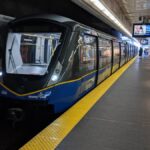
When the Mark II cars were delivered, the cars appeared completely white with the exception of the blue and yellow bands and word “SkyTrain” in blue near the front. However, the newer Mark II 1300/1400 series car came with an updated colour scheme: charcoal and blue separated by a thin stripe of yellow. The design is similar to those on the original Mark II cars except that the blue band is grey due to the background colour. The SkyTrain logo appears in white near the ends of the cars.

One of the system’s most notable features are the automated announcements and door chimes.  Karen Kelm originally voiced the station announcements with the famous “The next station is…” and then the name of the approaching station phrase. When the Millennium Line was completed in 2002, Laureen Regan took over as the voice of SkyTrain and now advertises the next stop and line the trains travel.
Also unique to the system, a three toned chime plays when the doors are about to close, which differs from the standard vocal warning used elsewhere. With the introduction of the Mark II 1300/1400 cars, an amber light in the doorway blinks when the chimes play providing a visual alert.

SkyTrain doesn’t utilize turnstiles at stations, but operates on a proof of purchase system. Passengers purchase fares from ticket vending machines or cards/passes from authorized vendors and retain them for the duration of the trip. Random checks are performed by SkyTrain Attendants or officers of the South Coast British Columbia Transportation Authority Police Service and can occur at any time; at entrances to the platform level, on the platforms and on board trains.
A plan to install turnstiles at all stations has been proposed by TransLink and is currently in the design phase.

SkyTrain outside of General Motors Place

SkyTrain outside of General Motors Place

The name SkyTrain comes from the fact, the majority of the system is elevated. The elevated structure is a viaduct constructed of prefabricated concrete sections and is designed so that pedestrians or traffic don’t have to encounter the trains or electrified rails. Some portions, including downtown Vancouver and between New Westminster and Columbia stations run underground, while sections between Nanaimo and Joyce, Edmonds and 22nd Street run at grade.
Under Vancouver, the SkyTrain runs in an old Canadian Pacific Railway tunnel, which was built in 1932, to connect the company’s yards on Burrard Inlet with the yards and shops on False Creek. The eastern portal is south of the Stadium station and is obscured by the recent construction of new high rises. The western portal is just north of the Burrard station, below the Vancouver Convention Centre. The tunnel’s width prevented both tracks from being run side-by-side, so the bottom was dug out, which allowed the westbound track stacked above the eastbound track.

The SkyTrain system is operated by the British Columbia Rapid Transit Company, a subsidiary of TransLink.
SkyTrain Map

Olympic Road Closures

  Frederick • January 14th, 2010 • Local
Olympic Clock

Olympic Clock counting down the days left

As the Winter Olympics draw closer, a number of streets in and around downtown Vancouver will be closed off or limited to authorized vehicles. The closures are expected to cause commuter headaches for those who live or work in the downtown core. Many streets will have parking restrictions in effect, so the best bet would be to take public transit. TransLink will have extra buses, run longer trains on the Expo and Millennium Lines and have increased frequency on the Canada Line and West Coast Express. More information on travel options and restrictions are available on the TravelSmart 2010 web site.

Closed Streets – No traffic or pedestrian access

  • Waterfront Road – Between the Vancouver Convention Centre and Crab Park
    January 27th to March 1st, 2010
  • Dunsmuir Viaduct – Between Beatty Street and Gore Avenue
    February 5th to March 2nd, 2010
  • Georgia Viaduct – Between Beatty Street and Gore Avenue
    February 5th to March 2nd, 2010
  • Expo Boulevard – Between Smithe Street and Quebec Street
    January 29th to March 2nd, 2010
  • Pacific Boulevard – Between Cambie Street and Quebec Street
    January 29th to March 2nd, 2010
  • Renfrew Street – Between East Hastings Street and McGill Street
    January 24th to March 1st, 2010
  • West 1st Avenue – Between Cambie Street and Quebec Street
    November 1st, 2009 to March 31st, 2010

Olympic Lanes – Limited to public transit and authorized vehicles
February 4th to March 1st, 2010

  • Burrard Street – Between Burrard Street Bridge and Cordova Street
  • Seymour Street – Between Granville Street Bridge and Cordova Street
  • Howe Street – Between Granville Street Bridge and Cordova Street
  • Pender Street – Between Beatty Street and Howe Street
  • Cambie Street – Between Cambie Street Bridge and West 59th Avenue
  • Broadway – Between Arbutus Street and Commercial Drive
  • Georgia Street – Between Richards Street and Stanley Park Causeway
  • Hastings Street – Between Richards Street and Boundary Road

Pedestrian Streets – No traffic from 12:00 pm PST to 12:00 am PST
February 12th to 28th, 2010

  • Granville Street – Between Davie Street and Cordova Street
  • Robson Street – Between Beatty Street and Jervis Street
  • Hamilton Street – Between Drake Street and Georgia Street
  • Beatty Street – Between Smithe Street and Dunsmuir Street

YVR Add Fare for Canada Line riders

  Frederick • January 7th, 2010 • Trains
Canada Line at YVR-Airport

Canada Line at YVR-Airport

Starting January 18th, 2010, passengers taking the Canada Line from the YVR-Airport, Sea Island Centre and Templeton stations, will be hit with an additional $5 when purchasing tickets. The fee, called Add Fare, will be added on automatically to all fares at ticket vending machines at these three stations. Passengers who are traveling to the airport will not be required to pay the additional $5.

The concept for the Add Fare was approved previously in 2004 to help fund the cost of constructing the new transit line, which runs from Downtown Vancouver to Richmond and Vancouver International Airport (YVR). Originally, TransLink had proposed to offer an additional $2.50 for passengers going to and from the airport and adjacent stations.

Commuters who hold pre-paid passes and cards, including FareSavers, monthly FareCards, Vancity U-Passes, and BC Government Bus Passes will not be affected by this.

Source: TransLink

Free rides on TransLink for New Year’s Eve

  Frederick • December 28th, 2009 • Local
SkyTrain at Commercial Drive

SkyTrain at Commercial Drive

TransLink will be offering free rides on New Year’s Eve, starting at 8:00 pm PST, Thursday, December 31st until end of service.

The Expo and Millennium Lines will extend their service by an hour, with the last train leaving at 2:16 am PST. The Canada Line’s last train will be at 2:05 am PST towards YVR-Airport and 2:15 am PST towards Richmond-Brighouse.

Service and fares will run on the Sunday/Holiday schedule for Friday, January 1st 2010.

Turnstiles in transit

  Frederick • December 17th, 2009 • Local
SkyTrain at Waterfront Station

SkyTrain at Waterfront Station

Starting next year, TransLink will be installing faregates at all SkyTrain, Canada Line, West Coast Express and SeaBus stations. At the same time, smart card technology, with reloadable cards, will be set up making it easier to take transit.

The smart cards will be the same size as a credit card and include a microchip that will contain the card’s total value. These cards can be loaded in person, over the phone or using the web. Similar technology exists in Seattle using the ORCA card or the Chicago Card/Chicago Card Plus in Chicago.

The project is expected to take request for proposals in early 2010, with work starting later in the year. TransLink expects the system to be fully functional in 2013. The Province of British Columbia, Government of Canada and TransLink will be funding the upgrades and installations, which has been given a budget of $171 million.

Currently, TransLink uses an honour system, where passengers purchase a fare and board without having to go through turnstiles. Fare checks are performed randomly on SkyTrain and the Canada Line by TransLink staff or transit police officers.

Source: TransLink

More taxes on parking and driving

  Frederick • December 7th, 2009 • Local, News

Vancouver-area residents are expected to be hit with additional taxes starting January 1st, 2010. Commuters will be paying extra for parking as well as filling up at the pump as TransLink tries to raise $150 million towards its operating budget.

The parking tax will remain until the new HST comes into effect on July 1st, 2010. After that, the tax will be merged into the HST and then given back to TransLink. The gas tax will add three cents to the current price at the pump.

Source: The Vancouver Sun

More SkyTrain track work

  Frederick • November 8th, 2009 • Local, Trains
SkyTrain at Waterfront Station

SkyTrain at Waterfront Station

TransLink will be replacing some of the rails on the track just west of the New Westminster station this month. This work will only be done during the weekends of the 7th to 8th, 14th to 15th and 21st to 22nd with one track out of service at a time.

Expo Line trains will be running on single platforms from the 22nd Street station to the New Westminster Station. Millennium Line trains will run from VCC-Clark to Columbia during this period. TransLink advises passengers to plan for delays during the work.

Rail replacement starts on Friday night and will continue until the following Monday morning.

More information is available on TransLink’s web site.

Editorial: Trains and Strollers

  Frederick • November 4th, 2009 • Editorials

A few weeks ago, an Australian mother had the fright of her life when the stroller holding her six month old baby rolled off the platform and in front of an oncoming train.  Then, this past Monday, another mother rushing to catch a southbound CTA Red Line train in Chicago watched as the train doors closed on her 22 month old daughter’s stroller and pull it down the platform. Miraculously, neither child was seriously injured in either incident.

I’ve seen far too many cases while riding the SkyTrain in Vancouver where parents rushing to get on a train and push their strollers in between the closing doors. It’s pretty stupid to be standing in the train hearing the shouts “Hold the train!” while seeing a large stroller caught and watching the doors re-open and close again making sure that whatever was stuck is now free.

First of all, it’s dangerous. When the doors close, stand back and let the train go. It’s bad enough the kid has to suffer the fact that these two metal doors are approaching them on either side and when they hit the carriage, it’s enough to wake them up or scare them. Worse yet, if the child is in one of those cheap easy-to-fold strollers, the results could be disastrous.

Secondly, it’s incredibly stupid. You’re risking your infant’s life (and quite possibly your own) instead of waiting for the next arrival. There will be another train. A five minute wait is better than the five minutes spent watching the train doors consume your infant and stroller. It’s totally not worth it.

Don't let these close on you!

Don't let these close on you!

The doors on SkyTrain are meant to re-open and then close if they detect something obstructing them. If the obstruction isn’t cleared, the doors will continue to re-open and close another four times before the train stops. Not stops as in no longer leaving the station, but as in stops and requires to be taken out of service. On Chicago’s CTA, the trains are not automated, and the rail operator is always seen peeking out from the front making sure everyone is on board before closing the doors. With SkyTrain, this isn’t the case as the system is completely automated, so that extra human safety element isn’t there. The chimes or announcement mean that the doors are closing. It doesn’t mean sprint.

Next time you’re at the station with your infant in a stroller, don’t rush and try and burst onto the train when the doors are almost closed. Don’t let go of your stroller either. It just takes one careless moment to turn into a huge disaster that no-one should experience. Safety begins with you, so take your time, don’t run and most importantly: don’t stick your kid between closing doors!

SkyTrain service change in downtown Vancouver

  Frederick • October 13th, 2009 • Local, News, Trains

Beginning on October 14th 2009, TransLink will be performing repair work in the Dunsmuir Tunnel on the route used by Expo and Millennium Line SkyTrains, to address water seeping into the 77 year old tunnel.  This work is scheduled to be completed by December 11th, 2009

Starting at 9:45 PM PDT until the end of service, trains headed to Waterfront will stop at the Stadium-Chinatown Station. A shuttle train has been setup to run on the outbound track and will stop at Granville, Burrard and Waterfront Stations running on 12 minute intervals.

TransLink recommends taking an extra 15 or 20 minutes during travel during this time. SkyTrain Attendants will be available to assist during the service changes.

SkyTrain service will be running at normal levels on October 28th, November 5th, and November 11th, 2009. Canucks fans may experience some minor delays as the work also falls on a number of home games at GM Place.

Full details are available on the TransLink web site.


Inside nephrus.net

Streaming Anime

Streaming Anime
Our collection of licensed web sites streaming your favourite anime series online.

Vancouver 2010

Vancouver 2010
Events, venues, medal standings and news from the 2010 Winter Olympics in Vancouver, British Columbia!

Canada Line

Canada Line
Take a look at the latest transit line linking Vancouver, Richmond and the Airport.

San Japan 2.x

San Japan 2.x
A look back on a visit to San Antonio's premiere Japanese animation and cultural festival, San Japan.